Famous People
On this page...
IntroductionThis page will feature profiles of famous historical figures who appear to have some autistic traits, and who some people have suggested may even have been classed as on the autistic spectrum if they were alive today. The way I see it though, they are not alive now... they were of their own time, and Asperger syndrome is very much of our time. I don't think we should label people from the past, but I don't think it does any harm to look at the difficulties and characteristics they shared with us, so we can perhaps think about them in a new and thought provoking context. The busiest week for visitors this site has ever had was the week a news story broke around the world of an article in New Scientist that examined the possibility that Isaac Newton and Albert Einstein might have shown classic signs of Asperger syndrome. The claim was actually made by Simon Baron-Cohen of Cambridge University and Ioin James of Oxford University, and you can read the article at NewScientist.com. In balance, Glen Elliott, a psychiatrist from the University of California at San Francisco, expressed the view that being highly intelligent alone could have accounted for characteristics identified as being evidence of Asperger syndrome in these men. He also said that Einstein had a sense of humour and that made it unlikely he had Asperger syndrome (which I felt was weak and inaccurate point to make and I e-mailed him and told him so). For me though it is not an issue about whether some famous person long since dead had Asperger syndrome or not... I don't care. For me it is about the public perception of people with Asperger syndrome as it is now and battling the prejudices and stereotypes that are a problem for us ordinary people now . I think figures that people recognise and accept already help people to see the humanity and the validity of people with Asperger syndrome. To this end I will work through a selection of those famous people most often cited as having had autistic traits as and when I am able to research them, and I will not tell you my opinion, I shall just present the information as I find it, and you can come to your own conclusions. |
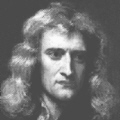
Isaac Newton
Born in 1643, Isaac was a small, intelligent boy, who was very quiet and serious and spent a lot of time by himself. When he did associate with others it was mostly with girls. "Sir Isaac was always a sober; silent; thinking lad, and was never known scarce to play with the boys abroad, at their silly amusements; but would rather choose to be at home, even among the girls, and would frequently make little tables, cupboards, and other utensils for me and my playfellows, to set our babies and trinkets on." Miss Storer (a childhood friend) He had a fascination for mechanics, and would lock himself away in a back room at his grandmothers house making kites, sundials and little mechanical devices. He would also construct exact replica models of carts and wheeled machines that amazed local people. One in particular was a working scale model of a new local windmill that was powered by a mouse on a wheel inside. At school though Isaac was only considered an average student by his teachers. In later life he apparently said that he had ignored much of his schoolwork in favour of spending more time on his own projects and interests. He was unpopular with the other boys. They thought him anti-social and he never made any friends. He wouldn't join in their games and instead of playing out with them after classes finished he would rush home to be by himself working on his models. Despite his real lack of interest in his school work at the time he was considered studious by the other boys and they envied his natural intelligence and talent for making stuff. Things came to a head when he was 14 and he got into a fight with the hated school bully. Despite being small and weak he won the fight through cunning and earned the respect of his peers for the first time. The new found self confidence this gave him encouraged him in his school work and he eventually became head boy at his school. Despite this, he almost never became a scientist, and was for a short while a farmer. However, he was absent minded and forgetful and was far from suited for such a practical and responsible job, and in 1661 he was admitted to Cambridge University instead. University life did not immediately appeal to Isaac. He was not impressed by the immaturity of his fellow students who seemed to him little different from the boys he had been at school with. He came from a strict protestant background and didn't drink or gamble either, so he soon gained a reputation for being boring and solemn. He did make friends with a fellow protestant student though, whom he shared rooms with, and he gradually started to take part in card games and trips to the tavern after few months once he was more relaxed and settled in. His studies soon began to become an all consuming priority to him though. He often got so engrossed in his work he would fall asleep at his desk or forget to eat meals. He had very little life away from his work, and his lack of social participation did not help his career within the university. "I never knew him to take any recreation or pastime either in riding out to take the air, walking, bowling, or any other exercise whatever, thinking all hours lost that was not spent in his studies." Dr Humphrey Newton (his assistant) He far from pushed himself forward in the scientific community at that time, and much preferred anonymity. Despite his secretive attitude about his work and his general reluctance to publish things due to his perfectionism, he was helped by his mathematics professor to get his work known so he could take the credit for his discoveries. "Newton ... was obsessed with the ideal of rigor and could hardly convince himself that anything was ready for publication" R. Westfall (a biographer) He soon became a professor of mathematics himself, but while the post suited his need to pursue his own investigations, it did also involve giving a few lectures, and Isaac was not a good speaker. Attendances were low, and one famous occasion when no one turned up at all Isaac continued to proceed with giving his lecture to the empty room. In 1672 he was invited to join the royal society, and despite squabbles and professional rivalries that made him lose interest for a while, he continued to make some of the greatest discoveries in science during the years that followed, which secured his position as one of the most well respected scientists in the world. He was not universally popular though and had disagreements and enemies within the scientific community throughout that time. In 1689 he was elected MP for the university and moved to London, but that only lasted a year and he did not seek re-election. However, he is said to have enjoyed London and to have had a social life there. Then at the age of 51 in 1694 he had a nervous breakdown brought on by depression and paranoia. Then In 1696 the opportunity came that got him back on his feet. He was offered the honorary title of Warden at the Royal Mint as a reward for his scientific achievements. The post required little of him, but he took it very seriously and worked very hard in updating and improving the countries coinage. He focused less and less on his scientific research as his work at the Mint kept him very busy. In 1703 he was elected president of the Royal Society, breathing new life into the organisation, and in 1705 he was knighted. As an older man though his eccentricities increased. In particular he became obsessed with capturing his likeness and had new portraits of himself done every couple of years, and he never ceased to be excessively distracted by his interests. " Even when he was an old man the servants had to call him to dinner half an hour before it was ready, and when he came down, if he chanced to see a book or a paper, he would let his dinner stand for hours. He ate the gruel or milk with eggs prepared for his supper cold for breakfast" John Conduitt (a close friend) He never married or had any children. He is said to have been a generous and charitable man, even witty and talkative at times, but he could also be difficult and argumentative and would not tolerate people disagreeing with him. Isaac Newton the scientist was widely respected, but Isaac Newton the man was disliked by some for his treatment of others and his attitudes. He died in 1727 at the age of 84. References: Isaac Newton by Michael White (1993), New Scientist, BBCi Website and other online sources. |
Further Reading Available From Amazon
Asperger's and Self Esteem by Norm LedginWell written, absorbing, sensible and much needed. Mr Ledgin examines the possibility that some of histories most loved and respected artists, musicians, and scientists may well have been on the autistic spectrum, and quite possibly achieved what they did not just despite their differences but perhaps even because of them. This book is not so much an attempt to diagnosis famous historical figures as a sincere look at what traits these people had in common with the autistic spectrum.. the objective being to remind those who receive this diagnosis, their families and their schools, that having difficulties with some things doesn't mean you lack potential or talent. There are drawbacks to this approach, but if you find yourself curious then you will probably find this easy read both enjoyable and interesting. |
|
|
|
|

See Also...
|
Enjoy or contribute to this growing collection of creative endeavour |
|
Examine the possibility of suitable and satisfying employment |
|
Browse the extensive library of books by Autistic / Asperger authors |


